
It’s 95 degrees in Portland, the sun is beating down on your windshield, and you turn the key. The blower fan whirs, but instead of a blast of cold air, you get a warm breeze that feels like standing next to an open oven door. You check the dashboard; the A/C light is on. So, what’s wrong? Before you panic or assume you need a $1,500 compressor replacement, you need to understand the language of your car’s cooling system: AC pressure. Reading those gauges correctly can save you hundreds of dollars in unnecessary repairs.
Air conditioning pressure testing is the process of measuring the refrigerant pressure within a vehicle's closed-loop system to diagnose leaks, blockages, or component failure. It isn't just about checking if the system is "full." It’s about understanding the relationship between temperature, speed, and pressure. If you’ve ever seen a mechanic attach two colored hoses-one blue, one red-to your car’s engine bay, you’ve witnessed this diagnostic procedure. Here is how to make sense of those numbers so you aren’t guessing when you walk into the shop.
The Basics: High Side vs. Low Side
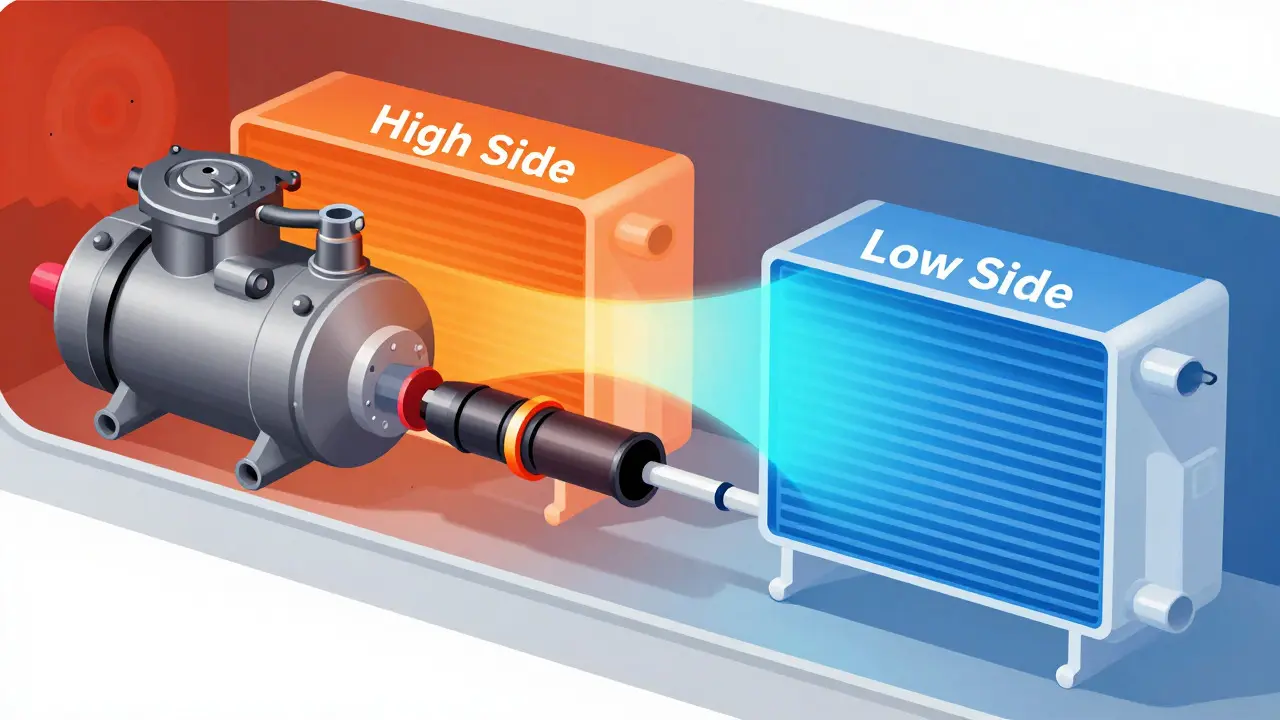
Your car’s A/C system operates on a cycle of compression and expansion. To understand the readings, you first need to know where the gauge is connected. There are two main sides to the system, and they serve very different purposes.
- Low-Side (Suction) Line: This is the thin line running from the evaporator core (inside your dashboard) back to the compressor. The refrigerant here is a cold gas with low pressure. Technicians connect the blue hose here.
- High-Side (Discharge) Line: This is the thick line running from the compressor to the condenser (in front of the radiator). The refrigerant here is hot and under high pressure. Technicians connect the red hose here.
A healthy system maintains a specific balance between these two sides. If one side is too high and the other too low, it tells a story about what’s broken. For example, a high high-side reading combined with a low low-side reading usually points to a restriction, like a clogged orifice tube or a failing condenser. Conversely, if both sides read low, you likely have a leak or insufficient refrigerant charge.
What Do Normal Readings Look Like?
There is no single "perfect" number for every car. Pressure depends heavily on ambient temperature, engine RPM, and the type of refrigerant used. Most modern vehicles use R-134a, while newer models (post-2017 in many markets) are transitioning to R-1234yf. However, we can look at general benchmarks for R-134a systems at idle (600-800 RPM) with the A/C set to max cool.
| System Status | Low-Side Pressure (PSI) | High-Side Pressure (PSI) | Possible Cause |
|---|---|---|---|
| Normal / Healthy | 25 - 35 PSI | 120 - 150 PSI | System operating efficiently |
| Undercharged | < 25 PSI | < 120 PSI | Leak or insufficient refrigerant |
| Overcharged | > 35 PSI | > 150 PSI | Too much refrigerant or oil contamination |
| Restricted Flow | < 25 PSI | > 150 PSI | Clogged orifice tube, blocked condenser, or failing compressor |
Notice how the "Restricted Flow" scenario creates a stark contrast: the low side starves for refrigerant because it can't pass through the bottleneck, causing the high side to spike as pressure builds up behind the blockage. This is why looking at only one gauge is dangerous. You need the delta-the difference between the two-to diagnose accurately.
Common Misconceptions About Pressure Gauges
Many DIYers buy a cheap manifold gauge set from an auto parts store and think they’re ready to go. While these tools are useful for a quick check, they often lead to misdiagnosis if used incorrectly. Here are the most common traps:
- Ignoring Ambient Temperature: Pressure is directly tied to outside air temperature. On a 50-degree day, your high-side pressure will be significantly lower than on a 90-degree day. Using a chart designed for 80-degree weather on a cool morning will make a healthy car look overcharged.
- Testing at Wrong RPMs: Compressor speed affects pressure. Testing at 1,500 RPM will yield higher pressures than testing at 600 RPM. Always note the engine speed when taking readings.
- Forgetting the Vacuum Pump: If you suspect a leak, adding refrigerant without pulling a vacuum first is a mistake. Air trapped in the system raises pressure artificially and reduces cooling efficiency. A proper recharge requires evacuating the system to remove moisture and non-condensable gases.
If your gauge reads 100 PSI on the low side, don’t immediately assume the compressor is shot. Check the ambient temp. If it’s 100 degrees outside, that might be normal. Context is everything in diagnostics.
When to Worry: Red Flag Readings
Some readings are immediate indicators of serious problems. If you see these, stop driving with the A/C on to prevent further damage.
- Zero Pressure on Both Sides: The system has lost all refrigerant. This almost always means a major leak, such as a burst hose or a failed seal. Driving with an empty system can cause the compressor to seize due to lack of lubrication (since refrigerant carries the oil).
- Extremely High High-Side (> 250 PSI): This indicates severe restriction or a stuck valve. The pressure relief valve (TXV) may open, but sustained high pressure can blow seals or crack the condenser.
- Fluctuating Gauges: If the needles jump up and down rapidly, you might have a failing compressor clutch cycling on and off, or a dirty condenser causing inconsistent heat exchange.
In Portland summers, humidity plays a role too. Moisture in the system turns into ice crystals in the orifice tube, restricting flow. This causes erratic pressure readings and reduced cooling. A vacuum pump removes this moisture, which is why professional recharges are more effective than DIY cans.

DIY vs. Professional Diagnostics
Can you do this yourself? Yes, but with limitations. A basic gauge set costs around $30-$50 and can tell you if the system is completely dead or grossly overcharged. However, diagnosing subtle issues like a partial condenser blockage or a slow leak requires precision. Professionals use digital gauges with data logging, UV dye lights to find leaks, and electronic TXV testers.
Here is a simple decision tree for drivers:
- No Cold Air + Zero Pressure: Take it to a shop. You need a leak test and recharge.
- Weak Cooling + Normal Pressure: Could be a faulty blend door actuator or electrical issue. Pressure won't show this. Get an electrical diagnosis.
- Strong Cooling but Warm Rear Seats: Likely a clogged heater core or blend door issue, not a pressure problem.
Don’t waste money replacing a compressor based on a guess. Pressure testing is the first step, not the last. It narrows down the field of suspects, allowing the technician to focus on the actual culprit.
Frequently Asked Questions
What is the ideal AC pressure for my car?
There is no single ideal pressure. It varies by ambient temperature and engine speed. Generally, for R-134a systems at 80°F ambient and idle, the low side should be 25-35 PSI and the high side 120-150 PSI. Always consult your vehicle’s service manual for specific specs.
Does high AC pressure mean I need a new compressor?
Not necessarily. High pressure often indicates a restriction (like a clogged condenser or orifice tube) or overcharging. A compressor failure usually presents as low pressure on both sides or zero pressure. Always diagnose the restriction before replacing expensive components.
How long does an AC pressure test take?
A basic visual and gauge check takes 10-15 minutes. A full diagnostic including leak detection, vacuum pumping, and recharging typically takes 1-2 hours depending on the complexity of the leak found.
Can I add refrigerant myself if the pressure is low?
You can top off the system with a can of R-134a, but it’s a temporary fix. If the pressure is low, there is likely a leak. Adding refrigerant without fixing the leak means you’ll lose it again in weeks. Also, DIY cans don’t remove moisture, which can corrode internal components over time.
Why does my AC pressure change when I drive versus when I’m parked?
When driving, airflow over the condenser helps dissipate heat, lowering the high-side pressure. When parked, the condenser relies on the electric fan, which is less efficient. Therefore, high-side pressure is typically 20-30 PSI higher when idling in traffic compared to cruising at highway speeds.