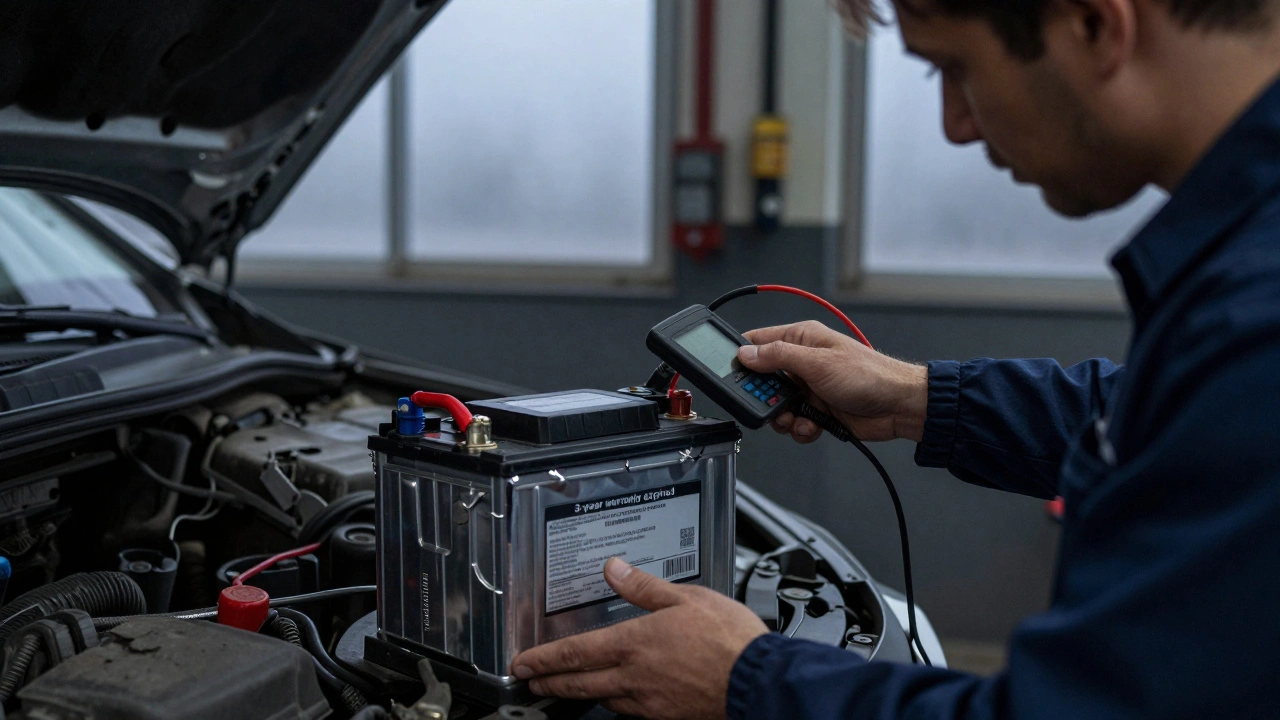
Most drivers don’t think about their car battery until it dies. But if you’ve ever been stranded with a dead battery, you know how expensive and inconvenient a replacement can be. That’s why understanding your car battery warranty matters-it can save you hundreds or even thousands of dollars. The good news? Not all warranties are the same. Factory batteries, aftermarket replacements, and EV batteries all come with different rules. Here’s what you actually need to know about coverage duration and how to get a claim approved.
Factory Car Battery Warranties: Shorter Than You Think
New cars come with a battery already installed. It’s easy to assume that because it’s part of the car, it’s covered under the same long-term warranty as the engine. But that’s not true. Factory batteries are covered under a separate, much shorter warranty.
Most automakers offer 3 to 5 years of coverage, but only for defects-not normal wear. For example:
- General Motors: 3 years or 36,000 miles for Chevrolet and GMC; 4 years or 50,000 miles for other GM brands
- Ford: 3 years or 36,000 miles
- Toyota: 3 years or 36,000 miles
- Luxury brands like BMW and Audi: Often 48 months (4 years)
These warranties only cover batteries that fail due to manufacturing flaws-like a cracked case, faulty terminal, or internal short. They don’t cover what happens to every battery over time: gradual loss of power. If your battery just won’t hold a charge after 3 years, that’s considered normal wear. No warranty applies.
Also, factory battery coverage ends when you sell the car. Unlike powertrain warranties that transfer to new owners, battery warranties are tied to the original buyer. If you bought a used car, the original battery warranty is almost certainly expired.
Aftermarket Batteries: Better Coverage, More Options
If you’re replacing your battery after the factory warranty expires, you’ll likely buy one from a retailer like AutoZone, Advance Auto Parts, or Les Schwab. These aftermarket batteries often come with far better terms than factory ones.
Most aftermarket batteries use a two-phase system:
- Free replacement period-if the battery dies within this time, you get a brand-new one for free.
- Pro-rated coverage-after the free period ends, you get partial credit toward a new battery based on how much warranty time is left.
Here’s what you’ll typically see:
- Entry-level batteries: 12 months free, 50 months total
- Mid-range batteries: 24 months free, 72 months total
- Premium batteries: 36 months free, 84 months total (7 years)
For example, Les Schwab’s Xtreme Plus battery gives you 24 months of free replacement and 84 months of total coverage. If your battery dies in month 50, you’d pay only a portion of the new battery’s price-based on how much of the 84-month warranty you’ve used. The retailer calculates it as: remaining warranty months ÷ total warranty months = credit percentage.
Some premium brands like Optima offer 36 months of free replacement with 36 months total coverage. That means no pro-rated phase-it’s all free replacement until the 3-year mark. AGM (Absorbent Glass Mat) batteries, which are more durable and common in modern cars, often come with longer warranties than standard lead-acid batteries.
One key advantage of aftermarket batteries: you can get service at any location of the same chain. If you bought your battery in Portland and moved to Seattle, you can still walk into any Les Schwab or AutoZone and get your warranty honored.
How Pro-Rated Coverage Actually Works
Pro-rated coverage sounds complicated, but it’s simple once you break it down. Let’s say you bought a battery with a 36-month free replacement and 48-month pro-rated period (84 months total). The battery costs $180.
If it dies in month 50:
- You’ve used 50 out of 84 months
- That means you’ve used about 60% of the warranty
- You’re entitled to 40% of the original price as credit
- 40% of $180 = $72 credit
- You pay $108 for the new battery
Most retailers have a minimum credit floor of 50%. So even if you’ve used 80% of the warranty, you’ll still get at least half the price back. This protects you from getting stuck with a huge bill if your battery dies just before the warranty expires.
Important: Replacement batteries don’t reset the clock. If you get a warranty replacement in year 2, the new battery still expires on the original purchase date. You won’t get a fresh 3-year warranty. Always keep your receipt-even if the store can look up your purchase by VIN, having proof avoids delays.

Hybrid and Electric Vehicle Battery Warranties
EV and hybrid batteries cost 10 to 20 times more than regular car batteries. A Tesla battery replacement can run $15,000. That’s why federal law requires automakers to cover them for at least 8 years or 100,000 miles.
Here’s what the major manufacturers offer:
- Tesla: 8 years or 120,000 miles, with a guarantee that the battery retains at least 70% of its original capacity
- General Motors: 8 years or 100,000 miles for EVs
- Ford: 8 years or 100,000 miles for Mustang Mach-E and F-150 Lightning
- Hyundai/Kia: 10 years or 100,000 miles for EVs
California goes further. Starting with 2026 model year EVs, the state requires batteries to retain 70% of their range for 10 years or 150,000 miles. By 2030, that standard jumps to 80% retention. Other states are likely to follow.
Unlike regular batteries, EV warranties cover degradation-not just sudden failure. If your battery drops below 70% capacity, the manufacturer must repair or replace it. This is huge. Most EV owners will never need a full replacement, but if their range drops significantly, they’re still covered.
EV battery warranties also transfer to new owners. That’s one reason why used Teslas and Leafs hold their value better than other EVs.
What’s NOT Covered: Common Warranty Exclusions
Even the best warranty won’t help if your battery fails for reasons outside manufacturing defects. Here’s what most warranties exclude:
- Normal wear: Batteries naturally lose capacity over time. If yours dies after 4 years, that’s expected-not a defect.
- Accidental damage: If you drop the battery, flood your car, or jump-start it wrong, you’re on your own.
- Improper installation: If a shop installs it wrong or damages the terminals, the battery maker won’t cover it.
- Commercial use: Batteries used in taxis, delivery vans, or fleet vehicles often have different (shorter) warranty terms.
- Wrong charger: Using a non-approved charger or leaving a battery on a faulty charger can void coverage.
- Environmental damage: Salt corrosion, acid leaks, or extreme heat/cold damage are usually excluded.
Some third-party extended warranties (like Endurance or CarShield) do cover wear-related battery failure-but they cost extra. If you’re planning to keep your car past 5 years, it’s worth considering.

How to File a Battery Warranty Claim
Here’s the step-by-step process to get your battery replaced under warranty:
- Test the battery: Most auto parts stores offer free battery tests. If it’s dead or below 70% capacity, you likely have a valid claim.
- Find your receipt: Keep it. If you lost it, call the retailer with your VIN or phone number. Many stores can pull up your purchase history.
- Visit the right location: Factory battery? Go to your dealership. Aftermarket battery? Go to any store of the same chain. Don’t try a different brand-they won’t honor it.
- Bring the old battery: Most warranties require you to return the failed unit. They’ll check it for signs of misuse or damage.
- Get the credit or replacement: If you’re in the free period, you walk out with a new battery. If you’re in pro-rated, you pay the difference. The retailer handles the rest.
Pro tip: If your battery dies in winter, don’t wait. Cold weather kills weak batteries. Get it tested before it leaves you stranded.
When to Replace Your Battery Before Warranty Runs Out
You don’t need to wait for your battery to die to replace it. Most experts recommend replacing a standard car battery at 3 to 5 years-even if it still works. Why? Because performance drops slowly. A 4-year-old battery might start your car on a warm day but fail in freezing temperatures.
If you’re close to the end of your warranty window, consider replacing it early. For example, if your battery has 6 months left on a 7-year warranty, buying a new one now gives you 7 full years of coverage. Waiting means you risk a failure with no credit.
For EVs, monitor your battery health through your car’s app. If your range drops more than 10% in 3 years, contact the dealer. You might qualify for a replacement before the 8-year mark.