That check engine light isn’t just a suggestion. It’s a digital distress signal from your car’s brain, telling you that something in the web of sensors, modules, and wiring has gone off-script. In modern vehicles, a simple dim headlight or intermittent no-start isn’t usually a loose bulb or a dead battery-it’s often a symptom of a deeper issue within the complex automotive electronic system. Trying to fix these problems by swapping parts until the light goes out is expensive, frustrating, and rarely works.
Real car electronics repair requires a shift in mindset. You aren't just fixing a broken wire; you are diagnosing a communication breakdown between intelligent components. This guide cuts through the noise and explains how professional technicians approach complex system troubleshooting, giving you the knowledge to understand what’s happening under the hood and why specialized diagnostics matter more than ever in 2026.
The Shift from Mechanical to Digital Diagnostics
Gone are the days when a mechanic could diagnose an engine issue by ear. Today’s vehicles are rolling data centers. A typical modern car contains over 70 electronic control units (ECUs) communicating via high-speed networks like CAN bus. When one sensor fails, it doesn’t just stop working; it sends erratic data that can confuse the engine management system, trigger false codes in unrelated modules, and cause drivability issues that seem completely random.
This complexity means that automotive electrical systems require a structured approach. Trial and error is obsolete. Professional shops now rely on manufacturer-specific diagnostic procedures, live data streaming, and waveform analysis to pinpoint root causes. The goal is not to guess which part is bad, but to prove it with data before any metal is turned or plastic is clipped.
The Diagnostic Workflow: How Pros Find the Root Cause
Effective troubleshooting follows a logical path. Skipping steps leads to misdiagnosis and unnecessary costs. Here is the standard workflow used by expert technicians:
- History and Symptom Verification: The technician asks detailed questions. When does the fault occur? Is it cold or hot? After rain? They then attempt to replicate the issue. If the problem is intermittent, they may use a road test with a scan tool recording live data to catch the glitch in action.
- Visual Inspection: Before plugging in tools, they look for obvious signs of damage: corroded battery terminals, melted connectors, chafed wiring harnesses, or blown fuses. A loose ground strap can mimic dozens of different electrical faults.
- Battery and Charging System Check: Voltage instability is the number one killer of electronics. A healthy 12-volt lead-acid battery should read around 12.6 volts with the engine off. With the engine running, the alternator must provide between 13.5 and 14.5 volts. Readings outside this range indicate a charging fault that can corrupt ECU memory and cause phantom errors.
- Code Retrieval and Analysis: Using an advanced OBD-II scan tool, technicians pull codes from all modules, not just the engine. Crucially, they distinguish between hard codes (current failures) and pending codes (intermittent issues). They also check freeze frame data to see exactly what the engine was doing when the fault occurred.
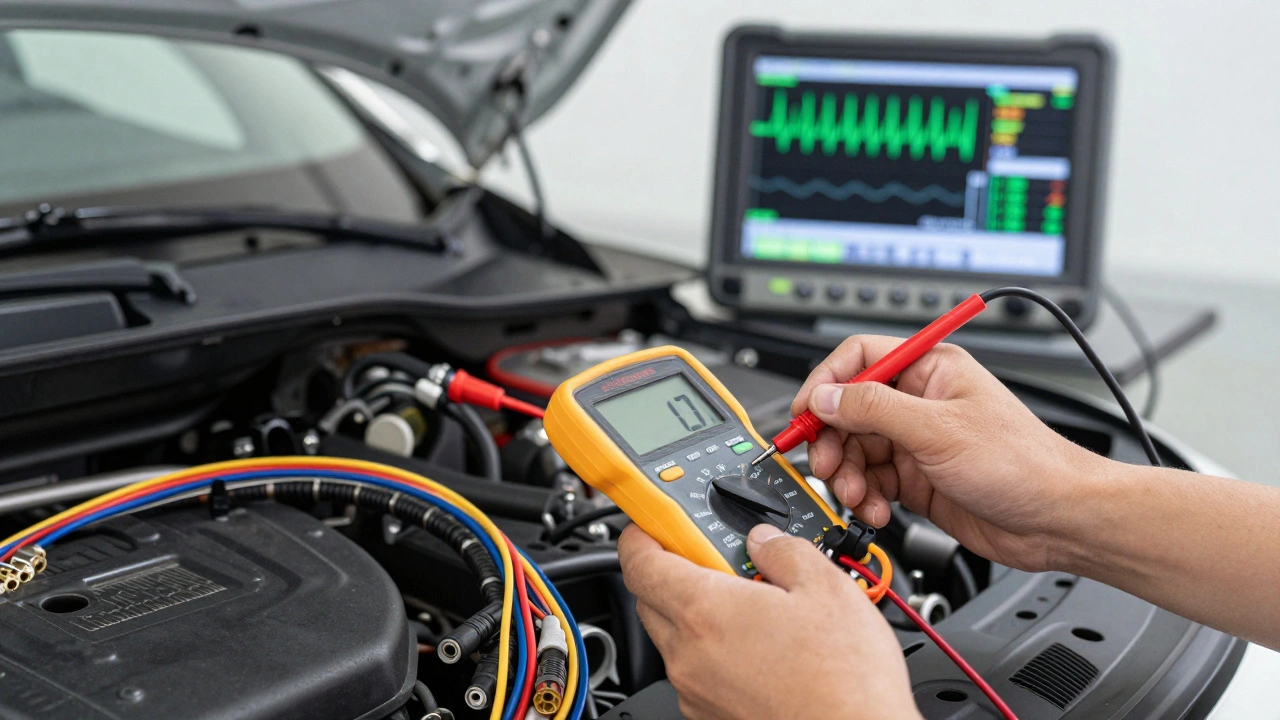
- Circuit Testing: This is where the real work happens. Technicians use wiring diagrams to trace circuits. They test for continuity, voltage drops, and short-to-ground conditions. A multimeter alone isn’t always enough; sometimes an oscilloscope is needed to view signal waveforms from sensors like crankshaft position sensors or oxygen sensors.
- Component Verification: Only after the circuit is proven good do they test the component itself. This might involve bench-testing a sensor or swapping a module with a known-good unit (if compatible) to confirm failure.
- Post-Repair Validation: The job isn’t done when the part is replaced. Technicians clear codes, perform a drive cycle, and re-scan to ensure the fault doesn’t return. They verify that all related systems are functioning correctly.
Essential Tools for Modern Electrical Diagnostics
You can’t troubleshoot complex electronics with a screwdriver and a prayer. The right tools make the difference between a quick fix and a week-long mystery.
| Tool | Primary Function | Why It Matters for Complex Issues |
|---|---|---|
| Advanced Scan Tool | Reads DTCs, views live data, performs bi-directional controls | Generic code readers only show basic engine codes. Advanced tools access ABS, airbag, infotainment, and ADAS modules, allowing comprehensive system checks. |
| Digital Multimeter (DMM) | Measures voltage, resistance, and current | Identifies high-resistance connections, parasitic draws, and open circuits that don’t trigger codes but cause performance issues. |
| Oscilloscope | Visualizes electrical signals as waveforms | Captures transient glitches and signal quality issues that a multimeter misses. Essential for diagnosing sensor timing and communication bus integrity. |
| Manufacturer Wiring Diagrams | Maps circuit paths, pinouts, and connector locations | Prevents guesswork. Shows exactly where to probe and what values to expect at each point in the circuit. |
Common Complex Faults and What They Really Mean
Many symptoms have deceptive roots. Understanding these common scenarios helps avoid costly mistakes.
- Intermittent No-Start: Often blamed on the starter motor. However, if the battery and charging system are healthy, the issue is frequently a faulty ignition switch, a bad ground connection, or a failing crankshaft position sensor. A voltage drop test on the starter circuit reveals hidden resistance that prevents adequate current flow.
- Dim or Flickering Lights: Rarely a bulb issue. Usually caused by poor grounding or an alternator regulator failing to maintain steady voltage. High resistance in the ground path forces the lights to share voltage with other loads, causing them to dim when the AC compressor kicks on.
- Repeated Blown Fuses: Indicates a short circuit. Simply replacing the fuse will blow it again. Technicians must isolate the short by disconnecting components along the circuit until the short disappears, then inspecting the last disconnected component or its wiring.
- Random Warning Lights: Multiple dashboard warnings appearing simultaneously often point to a network communication fault, such as a damaged CAN bus line or a failing gateway module. This disrupts data flow between ECUs, causing them to report errors even if their own sensors are fine.
Why Manufacturer Data Is Non-Negotiable
Every vehicle manufacturer designs their electrical systems differently. Pin assignments, voltage thresholds, and diagnostic procedures vary significantly between brands. Relying on generic experience or aftermarket guides can lead to incorrect repairs.
Professional technicians use subscription-based service information platforms that provide factory-level wiring diagrams, torque specifications, and step-by-step diagnostic trees. These resources are updated regularly to reflect technical service bulletins (TSBs) and software updates. For example, a specific model year might have a known issue with a particular sensor connector that requires a special sealing procedure-a detail only found in official manufacturer documentation.

The Future of Automotive Electronics Repair
As vehicles become more connected and autonomous, the role of the electronics specialist grows. Advanced Driver Assistance Systems (ADAS) like lane keep assist and automatic emergency braking rely on precise calibration of cameras and radar sensors. A misaligned camera after a windshield replacement can compromise safety features, requiring specialized alignment equipment.
Electric vehicles (EVs) introduce high-voltage systems that demand additional safety training and insulated tools. Diagnosing EV battery packs and inverters requires understanding both low-voltage control circuits and high-power electrical flows. The trend is clear: preventive electrical health checks will become as routine as oil changes, identifying potential issues before they strand drivers or damage expensive components.
Frequently Asked Questions
How much does complex car electronics repair cost?
Costs vary widely depending on the issue and vehicle. Labor rates for specialized diagnostics typically range from $150 to $300 per hour. Simple fixes like replacing a sensor might total $200-$500, while complex wiring repairs or module replacements can exceed $1,000. Always ask for a diagnostic fee estimate upfront, which is often credited toward the repair if you proceed.
Can I use a cheap OBD-II scanner for complex issues?
No. Cheap scanners ($20-$50) only read basic engine codes and clear them. They cannot access transmission, ABS, airbag, or body control modules, nor can they view live data streams or perform bi-directional tests. For complex troubleshooting, professional-grade tools costing thousands of dollars are required to interpret multi-system interactions accurately.
Why does my car have multiple warning lights on at once?
This often indicates a communication network failure rather than multiple simultaneous component failures. Modern cars use CAN bus networks to share data. If the network is disrupted due to a short, corrosion, or failing module, ECUs lose contact and throw default error codes. Fixing the underlying communication issue usually resolves most of the lights.
Is it worth repairing old car electronics?
It depends on the vehicle's value and the repair cost. For daily drivers, reliable electronics are crucial for safety and comfort. However, if the repair cost exceeds 50% of the car's market value, it may be more economical to replace the vehicle. Specialized shops can sometimes refurbish modules instead of replacing them, offering a middle-ground option.
What causes intermittent electrical problems?
Intermittent issues are usually caused by high-resistance connections, frayed wires inside insulation, or moisture intrusion in connectors. Vibration, temperature changes, and humidity affect these weak points, causing the fault to appear and disappear. Oscilloscopes are particularly effective at catching these transient events during testing.
Do I need special training to repair modern car electronics?
Yes. Modern automotive electronics require knowledge of circuit theory, network protocols, and manufacturer-specific diagnostic procedures. DIY enthusiasts can handle basic tasks like fuse replacement or battery testing, but complex module diagnostics and wiring repairs should be left to certified technicians with proper tools and training to avoid damaging sensitive computer systems.
How long does complex electronics troubleshooting take?
Time varies significantly. Simple code reads take minutes. Intermittent faults or obscure wiring issues can take several hours or even multiple days to isolate. Reputable shops will communicate progress and may need to leave the vehicle overnight to monitor recurring issues. Rushing the diagnostic process often leads to misdiagnosis and repeated visits.
Can a bad battery cause electronic glitches?
Absolutely. Weak batteries or failing alternators cause voltage fluctuations that confuse ECUs. Low voltage can make sensors report incorrect data, leading to limp mode or strange behavior. Many "electronic gremlins" are resolved simply by replacing a degraded battery or fixing a charging system issue, highlighting the importance of checking power supply first.