
Most people think more power means just adding a bigger turbo or swapping exhausts. But if your engine isn’t properly tuned, those upgrades might not do what you expect. You could end up with poor fuel economy, rough idle, or even engine damage. That’s where dyno optimization comes in - it’s not magic, it’s math. And it’s the only way to know exactly what your car is capable of.
What Dyno Tuning Actually Does
A dynamometer - or "dyno" - measures how much power your engine sends to the wheels. It’s not just about seeing a number like "420 horsepower." It’s about understanding how that power is delivered. Is it smooth? Does it drop off at 5,000 RPM? Are you burning too much fuel? A good dyno tune answers those questions.
Modern chassis dynos can handle everything from stock sedans to 3,000-horsepower drag machines. They simulate real road conditions by applying controlled resistance to the wheels while the engine spins. Sensors track dozens of variables: air-fuel ratio, ignition timing, boost pressure, exhaust gas temperature, oil pressure, even coolant and intake air temps. All of this data gets logged in real time. That’s how tuners know exactly where to make changes - not by guessing, but by measuring.
The Four-Step Process
Dyno tuning isn’t a one-run fix. It’s a process. Here’s how it works in practice.
- Inspection and Goals - Before the car even hits the rollers, the tuner checks spark plugs, air filters, fluid levels, tire pressure, and belt tension. If something’s worn out, tuning won’t help - it might make it worse. They also ask: Are you chasing more power? Better fuel economy? Smoother throttle response? Your goal changes everything.
- Baseline Test - The car is run on the dyno under stock settings. This creates a reference point. Maybe your 2023 BMW M3 makes 410 wheel horsepower on the dyno. But the factory claims 473 crank horsepower. That gap tells you how much power is lost in the drivetrain. This baseline becomes your starting line.
- Custom Calibration - This is where the real work happens. Using tuning software, the ECU’s fuel maps, ignition timing, and boost curves are adjusted. For turbocharged engines, boost pressure is fine-tuned across RPM bands. For naturally aspirated engines, airflow and throttle response are optimized. The tuner doesn’t just crank everything up - they find the sweet spot where power peaks without overheating or knocking.
- Validation and Repeats - After each change, the car is run again. Three or four runs are common. Why? Because engines need to warm up. Oil pressure stabilizes. Sensors settle. A single run doesn’t tell the full story. Consistency across runs is the real sign of a good tune.
What Data Matters Most
Not all numbers on the dyno screen are equal. Here’s what really counts:
- Wheel Horsepower (WHP) - This is the true number. Crank horsepower is what the engine makes before losses. WHP is what actually moves the car. A 500-hp engine might only deliver 420 WHP. That’s normal.
- Torque Curve - Torque is the pulling force. A flat, wide torque curve means strong acceleration from low RPMs. A narrow peak? You’ll feel a "power band" - strong in the middle, weak everywhere else.
- Air-Fuel Ratio (AFR) - Too rich (too much fuel)? Wastes gas and fouls spark plugs. Too lean (not enough fuel)? Causes overheating and detonation. The ideal AFR for gasoline engines under load is around 12.8:1 to 13.2:1. Leaner than 13.5:1 under full throttle is dangerous.
- Ignition Timing - Advanced timing (spark earlier) = more power. But too advanced = knock. Knock is bad. It can crack pistons. The dyno detects knock through vibration sensors. Tuners pull timing back just enough to eliminate it, then push it again to find the limit.
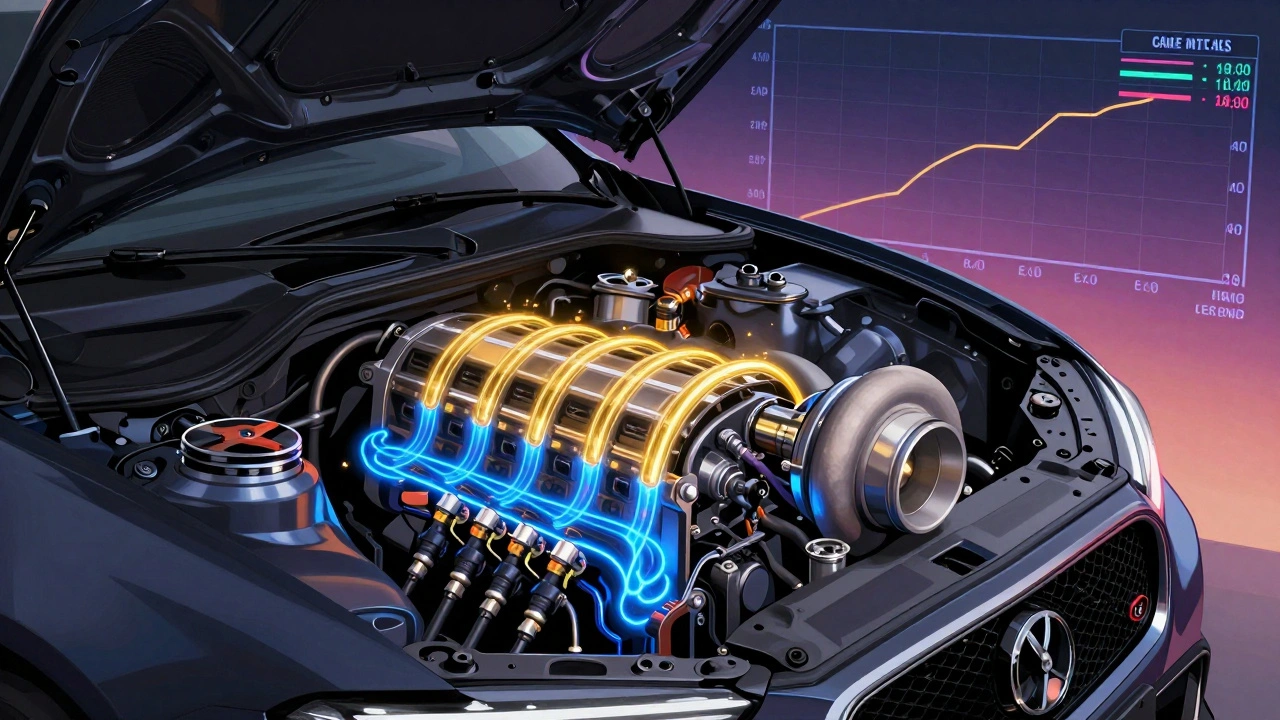
- Boost Pressure - For turbos, this is everything. A 1 psi increase can add 20-30 WHP. But if the fuel system can’t keep up, adding boost just creates a lean, dangerous condition.
Why It Works Better Than Guesswork
Online forums are full of "I added a cold air intake and gained 15 hp!" claims. But those are anecdotal. Without a dyno, you don’t know if it was real - or just placebo. Maybe the car was colder that day. Maybe the fuel was different. Maybe the tuner didn’t account for altitude.
Dyno tuning removes all that noise. It gives you repeatable, controlled results. You can test a new intake, a new exhaust, or a new ECU map - and see exactly what each change does. No more wondering. No more "maybe." Just data.
For example, a 2024 Porsche 911 GT3 with a cat-back exhaust and tune might gain 18 WHP and 14 lb-ft of torque - but only if the fuel map is adjusted to match the increased airflow. Without tuning, the exhaust alone might do nothing. Or worse, trigger a check engine light.
Real-World Benefits Beyond Power
People think dyno tuning is only for racers. But it helps everyday drivers too.
- Better Fuel Economy - A leaner, more precise fuel map can improve mileage by 5-10%. Especially if the car was running rich from the factory to meet emissions standards.
- Smaller Throttle Lag - Modern cars have "drive-by-wire" throttles that delay response. Tuning can make the throttle more responsive, making city driving feel livelier.
- Longer Engine Life - A properly tuned engine runs cooler and cleaner. No detonation. No overheating. No fuel starvation. That’s less stress on pistons, valves, and bearings.
- Diagnostic Power - If your car hesitates at 3,000 RPM, the dyno can pinpoint it. Is it a clogged injector? A failing MAF sensor? A vacuum leak? The data tells you.
Who Benefits Most?
Dyno tuning isn’t for everyone. But it’s essential for:
- Owners of modified cars - Aftermarket intakes, exhausts, turbos, cams - all need tuning to work right.
- Owners of turbocharged vehicles - Boost changes constantly under load. Without tuning, you’re flying blind.
- People who drive in high altitudes - Air density changes. Factory maps don’t adapt.
- Those who care about fuel efficiency - A tune can recover lost MPG from performance mods.
- Anyone with a high-mileage car - A tune can restore lost power from carbon buildup or aging sensors.
Even stock cars can benefit. Many manufacturers tune conservatively to cover global markets. A dyno tune can unlock hidden potential - often without touching hardware.
Pitfalls to Avoid
Not all "tuners" are created equal. Here’s what to watch out for:
- One-size-fits-all maps - If they’re selling a "pre-tuned" file off the internet, it’s not a real tune. Your car’s sensors, fuel quality, and mods are unique.
- Skipping the baseline - If they don’t test your car before tuning, they have no idea what they’re fixing.
- Ignoring safety limits - Pushing timing or boost beyond safe thresholds risks engine failure. Good tuners know the line.
- Using cheap or outdated dynos - A poorly calibrated dyno gives false readings. Always ask: "What brand is your dyno?" Inertia-based systems like Dynojet or SuperFlow are industry standard.
What Comes After the Tune?
Once you’re tuned, you’re not done. Here’s what to do next:
- Drive it for a few hundred miles. Let the ECU adapt. Some systems learn over time.
- Check spark plugs after 500 miles. They’ll tell you if the AFR is still correct.
- Monitor fuel economy. If it drops, something’s off.
- Keep records. Save the dyno printouts. They’re your proof of what was done.
Some tuners offer a 30-day guarantee. That’s a good sign. If they’re confident, they’ll stand behind their work.
Final Thought: It’s Not About the Number
The goal isn’t to get the highest horsepower number on the screen. It’s to make your car feel better - smoother, faster, more reliable. A well-tuned engine doesn’t just make power - it makes driving enjoyable. Whether you’re commuting, road-tripping, or hitting the track, dyno optimization turns guesswork into confidence.
Is dyno tuning worth it for a stock car?
Yes, especially if your car is older or driven in extreme conditions. Factory tunes are often conservative to meet global emissions and fuel standards. A dyno tune can unlock hidden power, improve throttle response, and even boost fuel economy by 5-10% without any hardware changes.
How long does a dyno tune take?
Typically 2-4 hours. The actual dyno runs take 10-20 minutes total. The rest is inspection, data analysis, making adjustments, and repeating tests. Rushing leads to bad results.
Can dyno tuning damage my engine?
Only if done poorly. A skilled tuner works within safe limits. They monitor knock, temperatures, and air-fuel ratios in real time. Poor tuning - like running too lean or too much timing - can cause damage. Always choose a reputable shop with experience in your car model.
Do I need to upgrade my fuel system before tuning?
Not always, but if you’re adding a turbo, supercharger, or large injectors, yes. The dyno will reveal if your fuel system can’t keep up. Running lean under load is one of the fastest ways to destroy an engine. Better to know before you tune.
Can electric vehicles be dyno tuned?
Yes. While EVs don’t have fuel or ignition systems, their motor controllers and torque maps can be tuned. Dyno testing helps optimize acceleration curves, regenerative braking settings, and thermal management. Some performance EVs gain 10-15% more power and better battery efficiency with custom tuning.