The Secret to Pricing: Working Backward
Most beginners make the mistake of taking the local price and adding a percentage for profit. Professional exporters do the exact opposite. They use a method called backward-calculation. Instead of starting at home, they start at the destination. If you are shipping from Canada to the US, you don't look at Canadian auctions first. You look at US wholesale data. Once you know what a vehicle actually sells for at a US auction, you subtract your target profit, your shipping costs, and your documentation fees. Whatever is left is the maximum amount you can pay for the car in Canada to make the deal work. To get a baseline, pros rely on the Manheim Market Report (or MMR), which provides real-time wholesale values. From the MMR baseline, you apply specific adjustments:- Trim Packages: A base model and a fully loaded luxury trim are two different products in the export market.
- Condition: Minor dents might be negligible in one market but a deal-breaker in another.
- Desirability: Some colors or engine options are cult favorites overseas.
The Math Behind the Profit
To avoid losing money, you need to track your Gross Profit per Unit (GPU). This isn't just the difference between the buy and sell price; it's what remains after every single operational cost is stripped away. When calculating your GPU, you must account for these four pillars:- Currency Differentials: The gap between the buying currency and the selling currency.
- Wholesale Benchmarks: The current market value at the destination.
- Target Profit: The minimum amount of money you need to make the effort worthwhile.
- Operational Costs: This includes the "hidden" killers like shipping, vehicle prep, customs clearance, and Registered Importer (RI) fees.
| Cost Element | Impact on Price | Variable Level |
|---|---|---|
| Shipping & Logistics | High | Distance dependent |
| Customs & Duties | Medium to High | Country specific |
| RI Fees | Fixed/Low | Per vehicle |
| Vehicle Prep/Detailing | Low | Condition dependent |
How Currency Swings Change the Game
Currency is the most volatile part of an export value assessment. A shift of just a few percentage points can turn a mediocre deal into a goldmine or a disaster. Take a look at early 2025. The US dollar dropped about 6% against the euro, the British pound, and the Japanese yen. For an American exporter, this was a huge opportunity. Because the dollar was weaker, US cars became significantly cheaper for buyers in Europe and Asia. Let's put some real numbers to that. If you had an American classic car valued at $50,000 in March 2025, a European buyer in April 2025 would have paid roughly €2,700 less for that same car purely because of the exchange rate. The car didn't change, and the market demand didn't change-only the currency did. On the flip side, if you were importing a European luxury car, that same 6% drop in the dollar would make the car more expensive. A €100,000 car would jump from roughly $108,000 to $114,000. If you didn't adjust your pricing model in real-time, you'd find your margins evaporating instantly.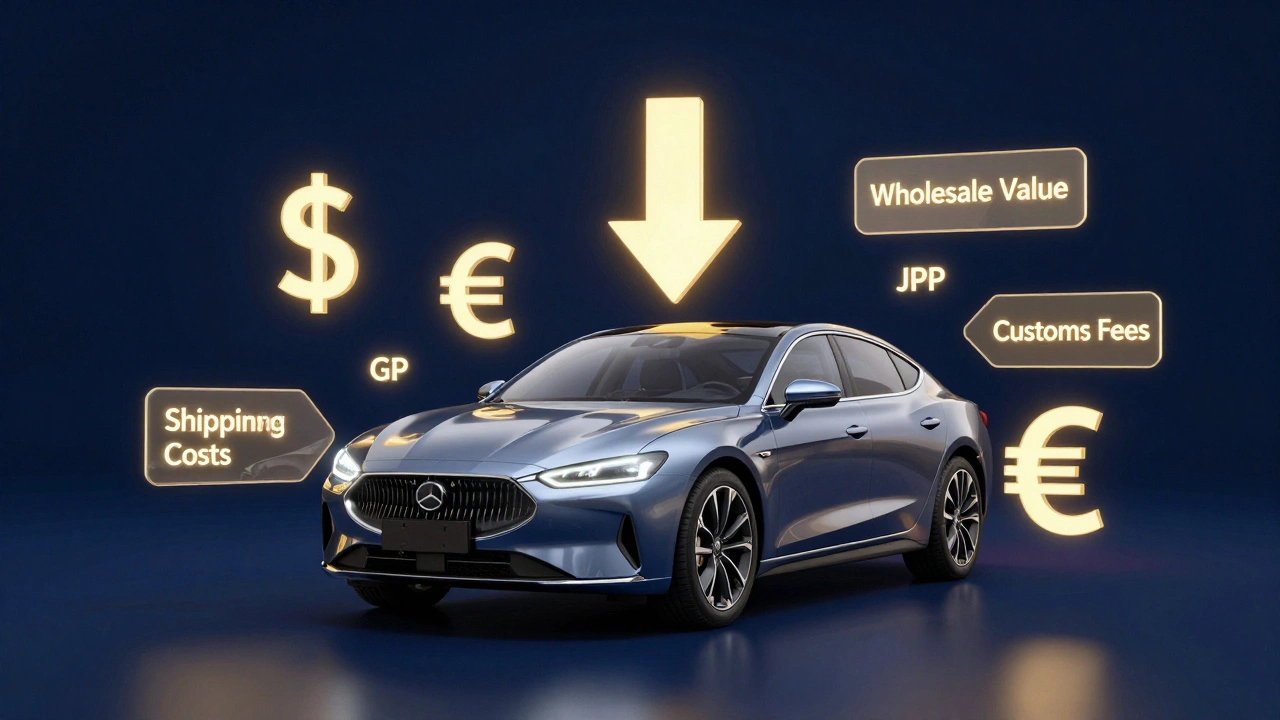
Navigating the EU and US Trade Corridor
The trade between the European Union and the US is one of the most active corridors in the world. Currently, EU passenger cars make up about 23% of all EU car exports to the US. There is a particularly strong trend in the low-emission vehicle segment. In 2024, the EU saw massive export values in this category, with the UK and US together absorbing about €21.3 billion of these exports. However, this is where policy risks enter the picture. Tariffs are the ultimate wildcard in export value assessment. If a government decides to slap a 50% tariff on imported vehicles, the valuation of your inventory crashes overnight. Scenario analyses show that such extreme tariffs could potentially reduce EU exports to the US by as much as €26.4 billion. When pricing for these markets, you can't just look at the car; you have to look at the political climate. If you see whispers of new tariffs, you need to speed up your inventory turnover. Holding onto cars while a trade war brews is a recipe for a massive financial loss.The Rising Cost of Parts and Logistics
It isn't just the cars themselves that are getting more expensive to move. The parts needed to get a car "export-ready" are seeing significant inflation. From late 2021 to late 2024, the prices for motor vehicle parts manufacturing rose by 17.1%. Why does this matter for valuation? Because every repair or modification you do to a car to meet the destination market's regulations (like lighting changes or emissions equipment) now costs more. If your value assessment is based on 2022 labor and parts costs, you are underestimating your expenses. You must integrate current parts inflation into your operational cost calculations to protect your GPU.
Practical Steps for Accurate Valuation
If you're getting into this, don't rely on a single source. The most successful exporters use a combination pricing mechanism. Here is a realistic workflow for assessing a vehicle's export value:- Step 1: Destination Research. Check the current wholesale value using MMR or local auction data in the target country.
- Step 2: Currency Conversion. Use the spot rate of the day, not the average of the month.
- Step 3: Cost Layering. Subtract shipping, RI fees, customs duties, and the cost of any required modifications.
- Step 4: Profit Margin. Subtract your target GPU.
- Step 5: Bid Limit. The remaining number is your absolute ceiling for the purchase price. If the car costs more than this, walk away.
What is the most common mistake in export pricing?
The most common mistake is "forward-pricing," where an exporter takes the local price and adds a guessed margin. Professional exporters always use "backward-calculation," starting with the destination's wholesale market value and subtracting costs to find the maximum purchase price.
How do currency fluctuations affect my profit?
Currency shifts can either inflate or deflate your margins. For example, a weaker US dollar makes US vehicles more attractive to foreign buyers, potentially increasing demand and allowing you to move inventory faster, though it may change the actual dollar amount you receive upon conversion.
What are RI fees?
RI fees are Registered Importer fees. These are costs paid to licensed professionals who ensure the vehicle meets all federal safety and emissions standards of the importing country and handles the legal paperwork required for customs clearance.
Why is the Manheim Market Report (MMR) used?
The MMR is considered the industry standard because it provides actual wholesale transaction data rather than just asking prices. This gives exporters a realistic baseline of what a vehicle is actually worth at auction.
How do tariffs impact vehicle valuation?
Tariffs act as an artificial price increase. If a 25% or 50% tariff is applied to a specific region's cars, the destination price must either rise (which kills demand) or the exporter must accept a much lower profit margin to keep the car competitive.