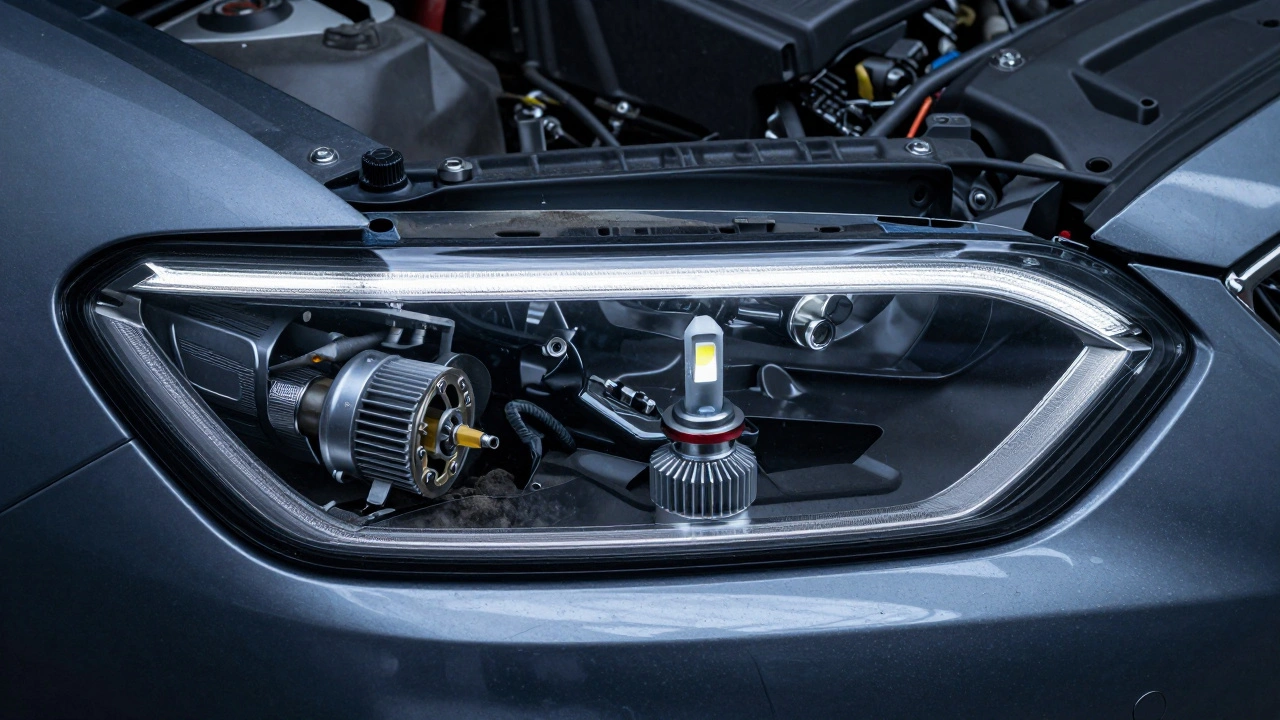
Swapping out old HID lights for modern LEDs is one of the best ways to sharpen your night vision on the road. But here is the catch: you can't just pull out a bulb and pop in a new one. If you try to treat an LED like a standard bulb without understanding the electrical differences, you risk frying your electronics or ending up with a dashboard full of warning lights. The real challenge isn't the bulb itself-it's the wiring.
The Core Difference: High Voltage vs. Steady Current
To fix the wiring, you first have to understand why it's broken. HID is High-Intensity Discharge lighting that uses a gas-filled tube to create a bright arc of light. Because it needs a massive jump-start to ignite, it relies on a Ballast-a device that cranks the voltage up to 20,000 or 30,000 volts. Conversely, LED is Light-Emitting Diode technology that converts electricity directly into light using semiconductors. LEDs don't need a high-voltage spark; they run on the standard 12V current your battery already provides. This means the ballast, which is the heart of an HID system, is completely useless for an LED. In fact, trying to run an LED through an HID ballast is a recipe for disaster, often leading to thermal stress or immediate bulb failure.
The Best Path: Ballast-Bypass Wiring
If you want a reliable setup, the HID to LED conversion should involve a "ballast-bypass" or direct-wire method. Instead of trying to trick the old system, you effectively delete the ballast from the equation. You rewire the fixture so the power flows from the vehicle's harness directly to the LED driver. While this sounds intimidating, it's actually simpler because it strips away the complex ignition requirements of the old HID setup. You'll find this works well across different systems, whether you're dealing with 120V or 277V setups. The trade-off is that you'll spend more time stripping wires and using connectors than you would with a cheap "plug-and-play" kit, but the reliability is significantly higher.
| Feature | HID System | LED System |
|---|---|---|
| Power Source | Requires Ballast | Direct 12V/DC |
| Ignition Voltage | 20,000V - 30,000V | Standard Vehicle Voltage |
| Heat Profile | High Thermal Output | Lower (requires heat sinks) |
| Longevity | Moderate (dims over time) | Very High |
Handling the "Computer" Problems: CANBUS and Decoders
Modern cars are smart-sometimes too smart. Your car's computer uses a CANBUS (Controller Area Network Bus) to monitor the health of your lights. Because LEDs draw much less power than HIDs, the computer might think the bulb is blown and trigger a "Bulb Out" warning on your dash, or worse, it might shut off the power to the headlight entirely to protect the circuit. To fix this, you need a CANBUS Decoder or a load resistor. These components mimic the electrical draw of the original HID bulbs, essentially lying to the car's computer so it thinks everything is normal. Without these, you'll likely deal with flickering lights or annoying dashboard alerts.
Solving the Reverse Polarity Puzzle
One of the most common "panic moments" during installation is when you flip the switch and nothing happens. If the connections look solid but there's no light, you likely have a polarity issue. Halogen bulbs don't care which way the electricity flows, so manufacturers often wired them randomly. LEDs, however, are polar-they only work if the positive and negative wires are in the right spots. If your light doesn't ignite, don't assume the bulb is dead. Simply rotate the connector that plugs into the vehicle's factory harness 180 degrees. For those still using a ballast-style connector, rotate the 2-pin oval connector on the ballast. Usually, this simple flip solves the problem instantly.
Step-by-Step Installation Workflow
To avoid short circuits or damaging your vehicle's ECU, follow this sequence:
- Safety First: Turn off the engine and disconnect the negative battery terminal. This prevents accidental sparks when you're stripping wires.
- Clear the Deck: Remove the old HID bulbs and the ballasts. In trucks like a 2014 Ford F-150, you'll see the ballast mounted at the bottom of the housing with specific green (power) and black (ground) wires.
- The "Ghost" Ballast Trick: You don't actually have to throw the old ballast away. While it's electrically useless, keeping it bolted in its original spot serves as a dust and dirt shield, preventing debris from entering the headlight housing. Just disconnect all the wires leading to it.
- Wiring the LED: Connect the LED driver directly to the power source. Use easy-connect wire connectors if your kit provides them. Strip a small amount of insulation, slide the wire into the locking tab, and tug gently to ensure a tight fit.
- Tuck and Secure: Use zip ties to secure any loose wiring. If wires dangle, they can vibrate against the chassis, wear through their insulation, and cause a short.
- The Final Test: Reconnect the battery and test the beams. Check for "flicker" and ensure the beam alignment hasn't shifted, which could blind oncoming drivers.
Troubleshooting Common Failures
Even with a guide, things go wrong. If one side is dim or doesn't work, check these in order:
- Polarity: Flip the connector 180 degrees.
- Fuse Capacity: Sometimes the LED's initial draw can trip a sensitive fuse. If the fuse is blown, try replacing it with one that is 5 amps higher to see if it stabilizes the circuit.
- Connection Integrity: Ensure the wire is actually touching the metal terminal inside the connector, not just the plastic housing.
- Driver Failure: If you've verified power is reaching the bulb but it's still dark, the LED driver (the small black box on the wire) may be defective.
Can I use my old HID ballasts with LED bulbs?
No. This is a major safety risk. HID ballasts produce high-voltage pulses to ignite gas, while LEDs require a steady, low-voltage current regulated by a driver. Using a ballast with an LED can cause the bulb to overheat, flicker, or burn out instantly.
What are D1S, D2S, and D4S?
These are specific HID bulb standards. When buying an LED conversion kit, you must match your kit to these specific codes because the physical socket and the wiring harness vary between these sizes.
Why are my LED headlights flickering?
Flickering is usually caused by a CANBUS error. The car's computer sees the low power draw and thinks the bulb is failing, so it repeatedly cuts and restores power. Installing a CANBUS decoder or a load resistor usually fixes this.
Do I need to align my beams after an upgrade?
Yes. While the bulb fits the same socket, the LED chip's orientation must be precise. If the bulb is slightly tilted, the light pattern will be off, which can create dangerous glare for other drivers.
Is it better to replace the whole headlight housing?
If you have the budget, replacing the entire assembly with LED-specific housings is the cleanest option. It eliminates the need for ballast-bypass wiring and ensures the optics are designed specifically for LED light sources.