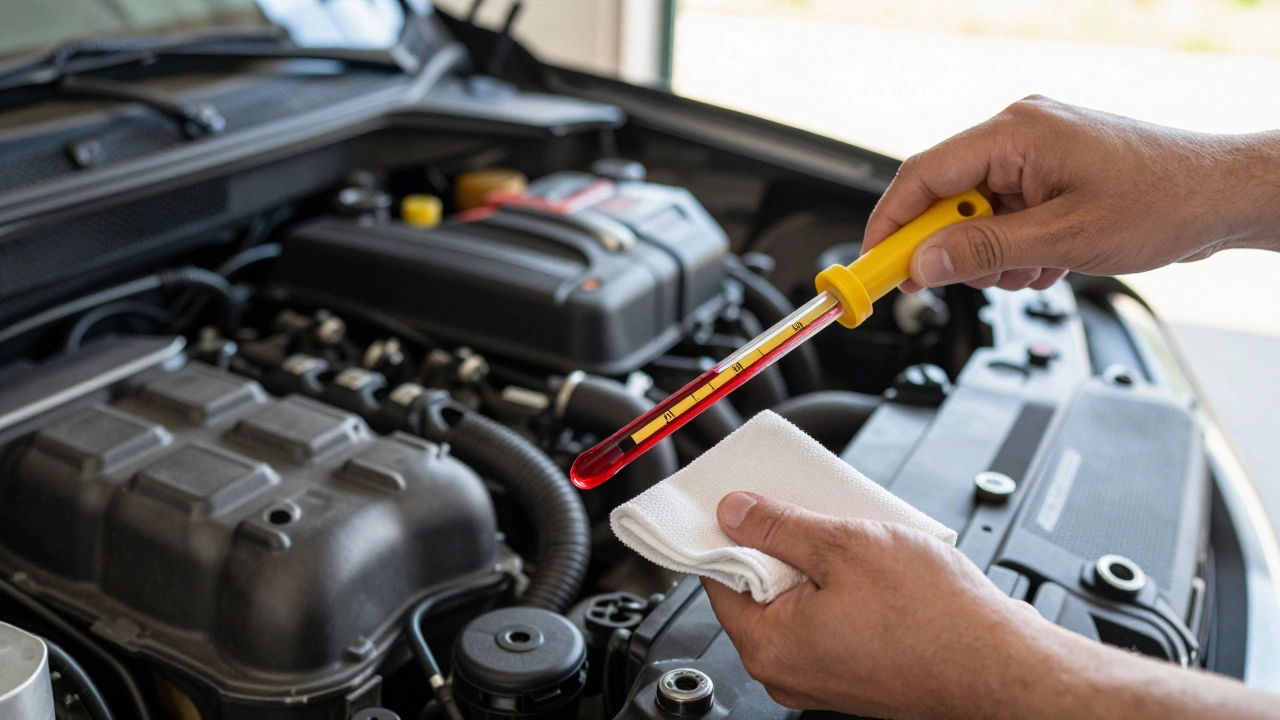
Most drivers know to check their engine oil, but far too many overlook their transmission fluid. Yet this fluid is just as critical-it keeps your gears shifting smoothly, prevents overheating, and stops internal parts from grinding together. If your transmission fluid is low or dirty, you could be looking at a repair bill that costs thousands. The good news? Checking and topping up your transmission fluid is something you can do yourself in under 15 minutes, if you know how.
Why Transmission Fluid Matters
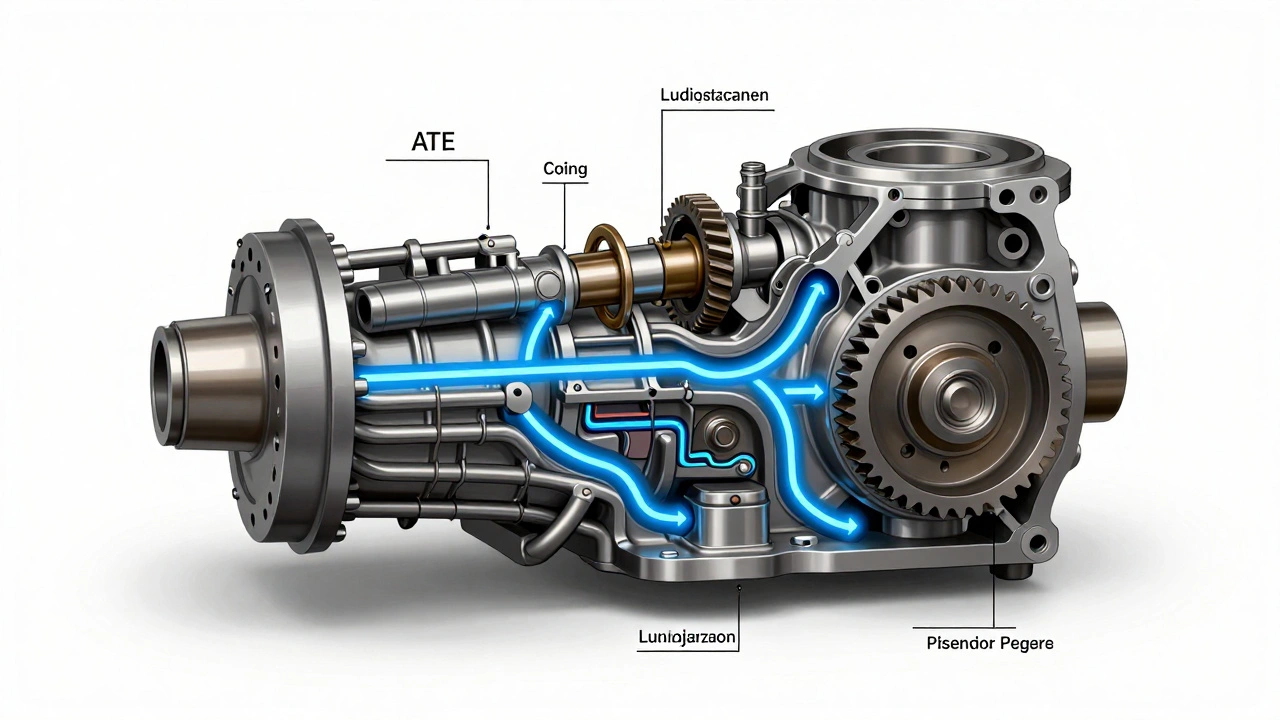
Automatic transmission fluid (ATF) isn’t just oil with a fancy name. It’s a specially engineered liquid that does three things: lubricates moving parts, cools the transmission, and creates hydraulic pressure to shift gears. When it gets low, old, or contaminated, your car won’t shift right. You might notice delays, rough shifts, or even a warning light on your dashboard. Left unchecked, low fluid can destroy your transmission-something no one wants to fix.Before You Start: Know Your Car
Not all cars are made the same. Some older models have a dipstick you can pull out. Others, especially newer ones, have sealed transmissions with no dipstick at all. You can’t check fluid in those without a scan tool or a professional. So first, open your owner’s manual. Look for the section on transmission maintenance. If it says "No periodic fluid checks required" or "Service by dealer only", skip the DIY and call a shop. If it mentions a dipstick, keep reading.Where to Find the Transmission Dipstick
The transmission dipstick looks a lot like the engine oil dipstick, which is why people mix them up. But here’s how to tell the difference:- The transmission dipstick is usually yellow or orange, while the oil dipstick is often yellow with a looped handle.
- It’s typically located toward the back of the engine bay, near the firewall, not near the front like the oil dipstick.
- Some dipsticks have a label that says "Transmission" or "ATF" right on the handle.
If you’re unsure, your manual will have a diagram. Don’t guess. Pulling out the wrong dipstick can lead to overfilling or damage.
How to Check the Fluid Correctly
This part trips up a lot of people. You don’t check transmission fluid like engine oil. Here’s the right way:- Start the engine and let it warm up. Drive the car for 10-15 minutes or let it idle for 5-10 minutes. The fluid needs to be at normal operating temperature-around 180°F (82°C). Checking it cold gives false readings.
- Keep the engine running. Unlike oil, transmission fluid is checked with the engine on.
- Shift through all gears-Park, Reverse, Drive, Neutral-then settle back into Park. This ensures fluid circulates properly.
- Engage the emergency brake. Make sure the car is on a level surface. Parking on a hill or driveway ruins the reading.
- Locate the dipstick, pull it out, wipe it clean with a lint-free rag, then fully reinsert it. Push it all the way down and pull it out again.
Now look at the fluid. Most dipsticks have two sets of marks: one for cold and one for hot. Always use the hot mark since you checked with a warm engine. The fluid level should be between the "Full" and "Add" lines. If it’s below the bottom line, you need to top up.
What the Fluid Should Look Like
Color and smell tell you more than the level.- Healthy ATF: Bright red or light pink, clear, with no burnt smell.
- Warning signs: Dark brown or black, thick, or smells like burnt toast. This means the fluid is degraded and needs to be changed, not just topped up.
- Gray or milky fluid? That’s coolant leaking into the transmission. You have a serious problem-get it checked immediately.
If the fluid looks bad, don’t just add more. You need a full fluid exchange. Adding fresh fluid to old, dirty fluid won’t fix anything-it’ll just dilute the problem.
How to Top Up Transmission Fluid
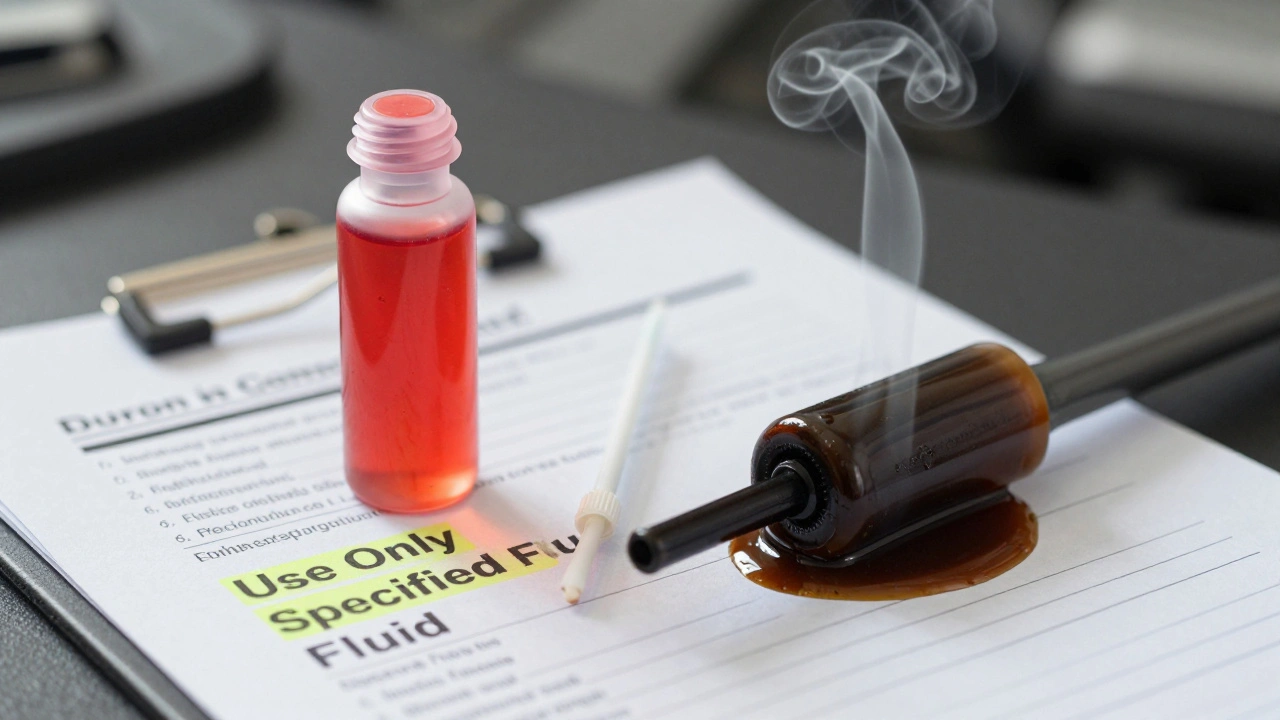
If the level is low and the fluid looks good, here’s how to add it safely:- Use the exact type of fluid your car requires. Check the manual. Brands like ELFMATIC CVT MV or ELFMATIC G3 are common, but your car might need a specific formulation like DEXRON-VI, MERCON LV, or ATF+4. Using the wrong fluid can cause shifting issues or damage.
- Get a long, narrow funnel. You’ll need it to fit into the dipstick tube.
- Slowly pour in a quarter of a quart (8 ounces) at a time. Don’t rush. Overfilling is worse than underfilling.
- After each addition, recheck the level with the engine running and in Park.
- Stop when the fluid reaches the "Full" mark on the dipstick. You’re done.
Most cars need between half a quart and one quart to top up from the low mark to full. Adding more than that without a full service usually means there’s a leak-and that’s something you should get looked at.
What If There’s No Dipstick?
Many 2015 and newer cars, especially from Toyota, Honda, Ford, and BMW, don’t have a dipstick. They use sealed transmissions with inspection plugs on the side of the transmission housing. To check fluid here, you need to:- Jack up the car and access the plug under the transmission.
- Remove the plug while the engine is running and warm.
- Fluid should drip out slowly. If it doesn’t, fluid is low.
- To add fluid, you need a special pump and the correct fluid-this isn’t a DIY job.
If your car doesn’t have a dipstick, you’re better off letting a shop handle it. Most manufacturers recommend checking fluid every 60,000 to 100,000 miles, but some say never. Stick to the manual.
Common Mistakes to Avoid
- Adding fluid with the engine off. You’ll get an inaccurate reading. Always check with the engine running.
- Using motor oil or generic fluid. ATF is not interchangeable. Using the wrong type can cause transmission failure.
- Overfilling. Too much fluid creates foam and pressure, which leads to leaks and overheating. It’s harder to remove excess than to add more.
- Ignoring fluid color. Dark fluid isn’t just low-it’s worn out. Top-up won’t fix it.
How Often Should You Check It?
Check your transmission fluid every 30,000 miles or at least once a year. If you drive in stop-and-go traffic, tow trailers, or live in a hot climate, check it every 15,000 miles. It’s a 5-minute task that can save you $3,000 in repairs.Some people think transmissions last forever. They don’t. The average automatic transmission lasts 150,000 to 200,000 miles-but only if the fluid is kept clean and at the right level. Skip this check, and you’re gambling with your car’s most expensive part.
Can I use any transmission fluid in my car?
No. Every car requires a specific type of automatic transmission fluid (ATF). Using the wrong fluid-like putting DEXRON-VI in a car that needs MERCON LV-can cause rough shifting, overheating, or even transmission failure. Always check your owner’s manual for the exact fluid specification. Brands like ELFMATIC CVT MV or ELFMATIC G3 are designed for specific systems, but your car’s manual will tell you which one to use.
Why is the fluid level different when the engine is cold vs. hot?
Transmission fluid expands when it heats up. A cold engine gives a lower reading because the fluid is thicker and hasn’t circulated fully. That’s why manufacturers design dipsticks with two sets of marks: one for cold and one for hot. Always use the hot mark, because that’s when the transmission is operating normally. Checking cold might make you think you’re low when you’re not-or worse, make you overfill.
Is it okay to top up transmission fluid if it’s dark or dirty?
No. Dark, black, or burnt-smelling fluid means it’s degraded and no longer protecting your transmission. Adding fresh fluid to old fluid doesn’t clean it-it just mixes contaminants. If the fluid looks bad, you need a full fluid exchange, not a top-up. A simple top-up won’t fix shifting problems caused by dirty fluid.
Can I check transmission fluid on a slope or incline?
No. The fluid level must be checked on a level surface. If your car is tilted-even slightly-the fluid will pool to one side, giving you a false reading. Always park on flat ground before checking. A driveway or parking lot is fine. Avoid hills, ramps, or uneven pavement.
How much fluid do I need to top up?
Most cars need between half a quart (16 oz) and one quart (32 oz) to go from the low mark to the full mark. Add it slowly-quarter quarts at a time-and check the level after each addition. You can always add more, but you can’t easily remove excess. Overfilling causes foaming and pressure buildup, which can damage seals and cause leaks.