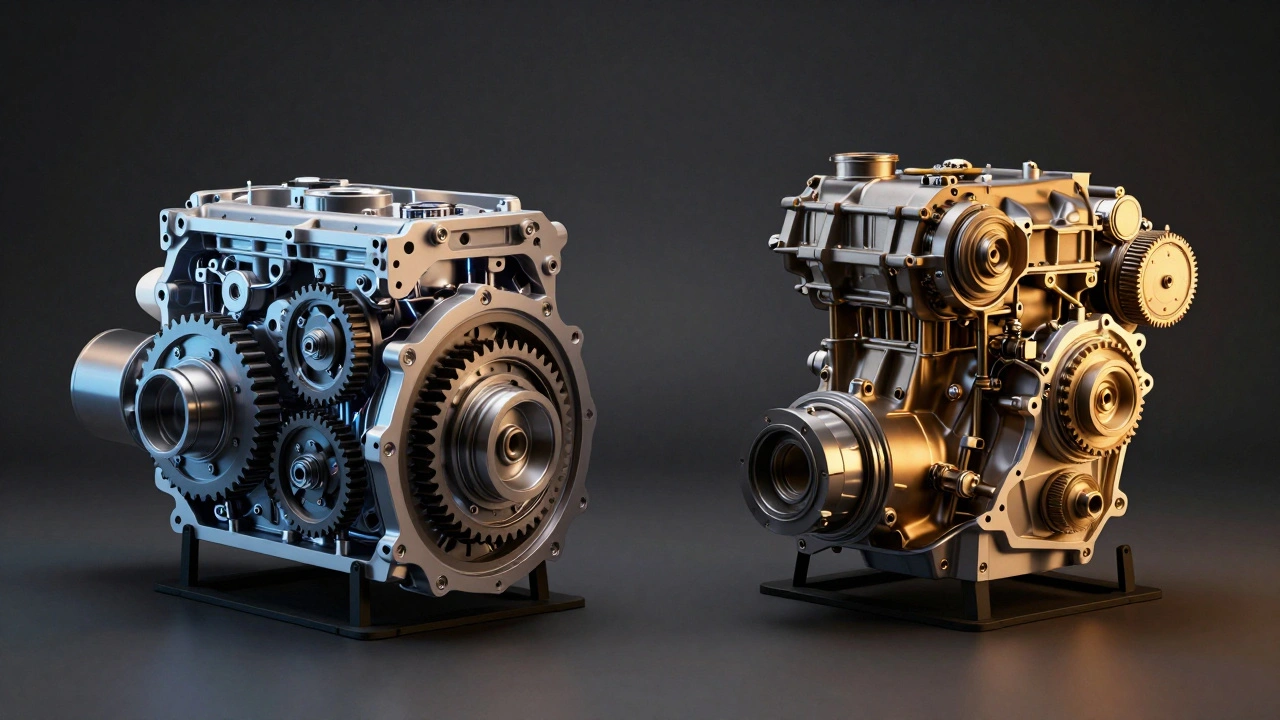
If you own an Audi, you've probably noticed that not all automatic transmissions feel the same. Some snap through gears with lightning speed, while others offer a smoother, more traditional glide. This is because Audi uses two very different technologies: S-Tronic is a sophisticated dual-clutch transmission (DCT) system that manages odd and even gears independently, while Tiptronic is a traditional torque-converter automatic transmission, often sourced from ZF. Mistaking one for the other during service isn't just a minor error-it can lead to using the wrong fluid, which is a recipe for a very expensive trip to the mechanic.
What Exactly is S-Tronic?
Think of an S-Tronic gearbox as two manual transmissions working together in one housing. It's branded as a DSG (Direct-Shift Gearbox) in many markets. While you drive it like an automatic, it uses two separate clutches. One clutch handles the 1st, 3rd, and 5th gears, while the other handles the 2nd, 4th, and 6th. Because the next gear is already pre-selected, the shift happens in milliseconds. This is why an Audi S4 or S6 feels so responsive when you floor it; there's almost zero interruption in power delivery.
Common versions include the 0B5 7-speed dual-clutch transmission, often found in high-torque variants like the DL501 used in the S-series. There is also the DL382 gearbox used in other lineup models. Because these systems are so precise and handle so much heat, they are far more sensitive to fluid degradation than a standard automatic.
Tiptronic: The Reliable Classic
Tiptronic is the older sibling in this family. It's a conventional automatic transmission that uses a torque converter instead of clutches to transfer power. You'll frequently find these in older Audi V6 models, such as the 5-speed ZF Tiptronic. While it doesn't offer the millisecond shift speeds of a DSG, it's incredibly smooth and generally more forgiving of missed service intervals.
The main takeaway here is that Tiptronic and S-Tronic are fundamentally different machines. You cannot use S-Tronic fluid in a Tiptronic gearbox, and vice versa. If you're shopping for parts or scheduling a service, the first question you must answer is: "Which system do I actually have?"
When to Change Your Transmission Fluid
If you ignore your transmission service, you aren't just risking a leak-you're risking the "mechatronics" unit, which is the brain of the gearbox. S-Tronic systems are high-maintenance. Audi typically recommends the first fluid change at 35,000 miles, with subsequent changes every 40,000 miles. Some aggressive drivers or those in heavy stop-and-go traffic might even see intervals as low as 25,000 miles.
Tiptronic systems are a bit more relaxed. Generally, these transmissions need fresh fluid every 50,000 to 60,000 miles. The gap in service frequency exists because the dual-clutch architecture of the S-Tronic creates more friction and heat, breaking down the oil faster.
| Feature | S-Tronic (DSG) | Tiptronic |
|---|---|---|
| Technology | Dual-Clutch (DCT) | Torque Converter |
| Shift Speed | Ultra-Fast (Milliseconds) | Smooth / Standard |
| Service Interval | Every 35k - 40k miles | Every 50k - 60k miles |
| Complexity | High (Mechatronics) | Moderate |
| Primary Goal | Performance & Efficiency | Comfort & Longevity |
S-Tronic Service: Parts and Specifications
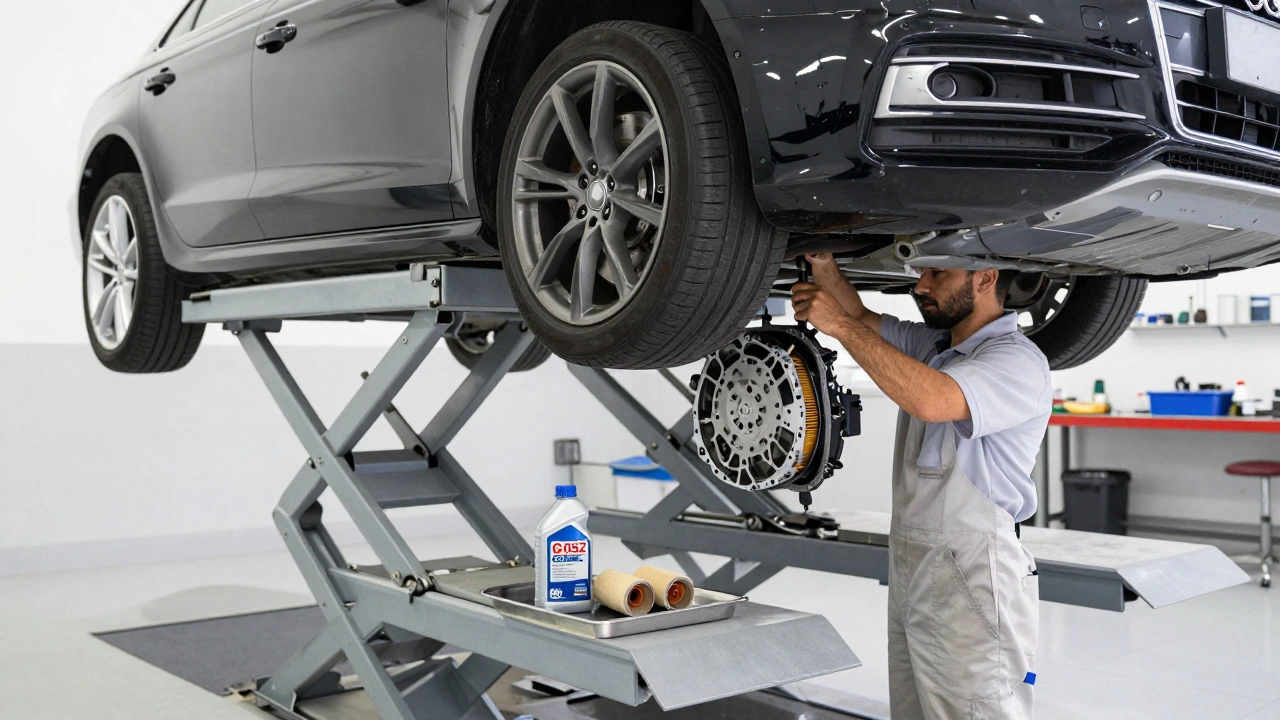
A proper S-Tronic transmission service is more than just a "drain and fill." Because the system is so complex, you have to replace several sealing and filtration components to keep the mechatronics clean. If you're doing this at a shop, make sure they are using the G 052 529 A2 fluid specification.
For a 0B5 7-speed DSG, you'll need about 7 liters of fluid. But the fluid is only half the battle. You also need to replace:
- The internal transmission filter (Part B 532 542 9E), which requires dropping the oil pan.
- The external transmission filter (Part B 532 533 0A).
- The filter gasket (Part WHT003379).
- The oil pan gasket (Part 0B5321371E), which must always be new to prevent leaks.
- The external filter cap (Part 0B5.325.240.C).
The Step-by-Step Service Process
Changing the fluid in an S-Tronic system is a precise operation. If the car isn't level, you'll underfill or overfill the transmission, both of which can cause shifting issues. Here is how a professional service is typically handled:
- Leveling: The vehicle is placed on a perfectly level lift.
- Draining: The fluid is drained via the drain plug.
- Filter Replacement: The oil pan is removed to swap the internal filter and gasket. The external filter is also replaced.
- Refilling: Fluid is poured through the fill tube in the engine compartment until it overflows from the fill hole.
- Thermal Cycle: The car is started and driven through all gears. The technician monitors the temperature until the fluid reaches exactly 38 degrees Celsius.
- Final Level Check: Once at temperature, the fluid level is checked and topped off one last time while the car remains level.
Warning Signs: Is Your Transmission Failing?
You shouldn't wait for a dashboard warning light to tell you your transmission is in trouble. By then, you might be looking at a full gearbox replacement. Instead, keep an eye out for these red flags:
- Cold Shifting Issues: If the car shifts harshly or "clunks" when you first start it in the morning, your fluid is likely degraded.
- Hesitation: A delay between shifting from Park to Drive or a pause during gear changes.
- Shuddering: A vibration or "shiver" felt during acceleration, especially in lower gears.
- Gearbox Alerts: Any "Gearbox Malfunction" message on the instrument cluster is a signal to stop and get a diagnostic scan immediately.
Pro Tips for Transmission Longevity
Want your Audi transmission to last 200,000 miles? Start with the "warm-up" rule. Don't launch your car or drive aggressively the moment you leave the driveway. Let the transmission fluid reach operating temperature first. This reduces the stress on the dual clutches and the mechatronics unit.
Also, be wary of "lifetime fluid" claims. No fluid lasts a lifetime. Even if a manual says otherwise, experienced Audi techs recommend following the 40,000-mile rule for S-Tronic systems. The cost of a routine fluid change-often between $125 and $140 at an independent shop-is nothing compared to the cost of a new transmission.
Can I use a generic transmission fluid in my Audi S-Tronic?
No. S-Tronic transmissions use a specific fluid (like G 052 529 A2) that acts as both a lubricant and a coolant for the mechatronics. Using generic fluid can lead to overheating, clutch slippage, and total transmission failure.
How do I know if I have S-Tronic or Tiptronic?
Check your vehicle's manual or the gear shifter. S-Tronic usually features very fast, seamless shifts and is common in newer A4, A5, and S-series models. Tiptronic is more common in older V6 models and feels like a traditional automatic.
Why is the 38°C temperature important during a fluid change?
Transmission fluid expands as it heats up. To ensure the level is exactly correct, Audi specifies that the final check must happen when the fluid is at 38 degrees Celsius. Too much or too little fluid can cause erratic shifting.
What is the "mechatronics" unit?
The mechatronics unit is an integrated electronic and hydraulic control system that manages the shifting process in S-Tronic gearboxes. It is highly sensitive to contaminants, which is why regular filter changes are critical.
Is it cheaper to service my Audi at a dealership or an independent shop?
Independent shops are generally cheaper, with total costs for an A4 Quattro fluid service ranging from $125 to $139. However, ensure the shop has factory-level diagnostic tools and uses OEM-spec fluids.
Next Steps for Audi Owners
If you're over 40,000 miles and haven't touched your transmission fluid, your first step is to verify your transmission type. Once you know if you have an S-Tronic or Tiptronic system, find a shop that specializes in European cars. Ask them specifically if they use the G 052 529 A2 fluid for DSG services and if they have the equipment to level the car perfectly during the fill process. If they seem confused by these requirements, keep looking-your transmission is too valuable to trust with a "one size fits all" approach.